


Jun 83 min read
May 289 min read
USE THIS SPACE TO PROMOTE YOUR BUSINESS
Updated: Mar 3
Paper trading has become one of the most popular ways for beginners to enter the stock market. If you're wondering, 'Can we make a profit with paper trading?' you're not alone. Many aspiring investors start here before risking real money.
Paper trading is a simulated trading process where investors buy and sell securities without using real money. In the past, traders literally wrote trades on paper. Today, online platforms offer virtual trading accounts that mirror live markets.
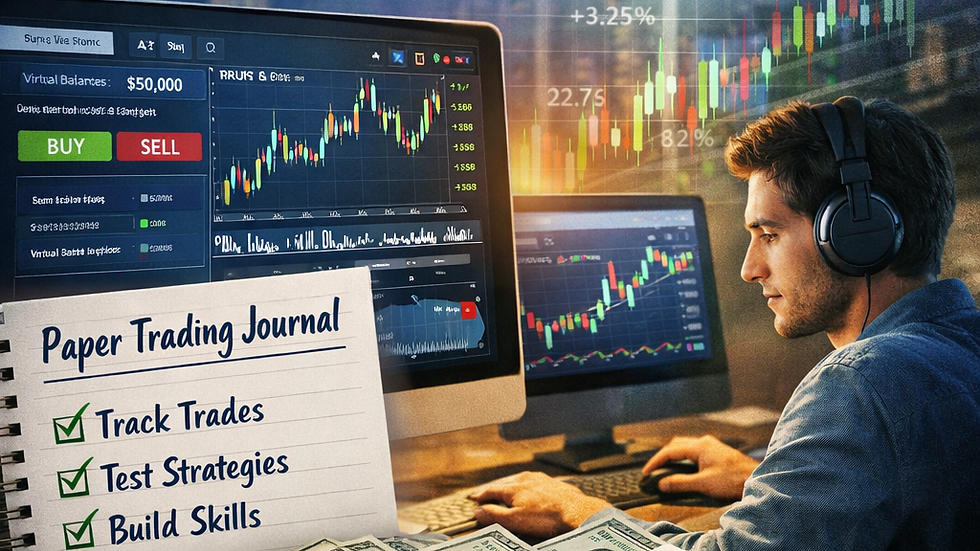
Traders use paper trading to:
Practice strategies
Understand market movements
Learn order execution
Build confidence
Avoid financial loss during learning
It’s like a flight simulator for pilots. You practice safely before flying the real aircraft.
This is the big question: can we make a profit with paper trading? The simple answer is yes — but only virtually.
When you trade on a simulator, your gains are theoretical. You may see impressive returns, but no real money enters your bank account. However, the skills you gain can help you earn real profits later. Paper trading profits represent:
Strategy effectiveness
Market understanding
Risk management capability
Discipline in execution
But remember, virtual success doesn’t always guarantee real-world success.
Here’s where things get interesting. When no real money is at stake, emotions are minimal. You’re calm, logical, and bold. However, in live trading, fear and greed kick in. This emotional difference explains why some traders perform brilliantly in simulations but struggle in real markets.
If you truly want to know if we can make a profit with paper trading, follow this structured 9-step strategy.
Decide what you want to learn:
Day trading?
Swing trading?
Long-term investing?
Clarity prevents confusion.
Select a realistic trading simulator. Look for:
Real-time data
Order execution tools
Performance tracking
The closer it feels to real trading, the better.
Your plan should include:
Entry rules
Exit rules
Risk limits
Position size
Without a plan, you're just guessing.
Never risk more than 1–2% per trade, even in simulations. This builds discipline.
Maintain a trading journal including:
Reason for entry
Outcome
Emotional state
Lessons learned
Learn how markets move:
Bull markets
Bear markets
Sideways trends
Observe patterns carefully.
Understand indicators like:
Moving averages
RSI
Support and resistance
Technical knowledge improves accuracy.
Analyse your performance weekly. What worked? What didn’t? Continuous improvement is key.
Start small. Use minimal capital. Apply what you've learned without risking too much.
Paper trading offers several advantages:
Zero financial risk
Skill development
Strategy testing
Emotional control practice
Performance tracking
It’s an educational playground.
However, paper trading isn't perfect. Be aware of:
No emotional pressure
Unrealistic order fills
Overconfidence risk
No real financial consequence
This is why traders must treat simulations seriously.
Confidence in trading comes from preparation. Paper trading allows repeated practice. When you consistently execute a strategy successfully, you develop trust in your method. That trust becomes crucial when real money is involved.
Many traders misuse paper trading. Avoid these pitfalls:
Taking unrealistic risks
Ignoring stop losses
Switching strategies too often
Not tracking results
Jumping too quickly to live trading
Discipline is everything.
Here’s a comparison:
| Factor | Paper Trading | Real Trading |
|----------------|---------------|---------------------|
| Risk | None | Real financial risk |
| Emotion | Low | High |
| Learning | High | High but costly |
| Consequences | Virtual | Financial |
The biggest difference? Emotions.
Before transitioning to live trading, educate yourself using trusted sources like the U.S. Securities and Exchange Commission. Their educational portal provides investor guides and fraud alerts. You can also explore investor education at https://www.investor.gov/. Learning from credible institutions strengthens your foundation and demonstrates responsible investing.
No. Profits are virtual. However, the skills gained can lead to real profits later.
Most experts recommend 3–6 months of consistent practice.
Absolutely. It’s the safest starting point for new traders.
No guarantee exists. Emotional control and discipline matter greatly in real markets.
Risk-free learning while testing strategies.
Only after consistent profitability, strong discipline, and a tested strategy.
So, can we make a profit with paper trading? Yes — but only virtually. The real value lies in education, skill-building, and disciplined practice. Paper trading acts as a bridge between theory and real-world investing. If approached seriously, it can transform beginners into confident traders. However, success ultimately depends on discipline, emotional control, and continuous learning.
Paper trading isn’t a shortcut to riches. It’s a training ground. Use it wisely, follow a structured plan, and you’ll significantly improve your chances of earning real profits in live markets.


Comments