
Asset Allocation Strategies for 2026 Market Volatility: The Optimal Mix of Stocks, Bonds, and Gold

Market volatility is expected to remain a defining feature of global financial markets in 2026. Rapid shifts in interest rates, geopolitical uncertainties, technological disruptions, and evolving economic cycles have made traditional investing strategies less reliable. In this environment, asset allocation becomes the most powerful tool for protecting wealth while capturing growth opportunities.
A well-structured portfolio that balances stocks, bonds, and gold can help investors navigate uncertainty while maintaining long-term capital appreciation. By strategically allocating assets across these three pillars, we create a resilient investment structure capable of absorbing shocks and benefiting from market cycles.
This comprehensive guide explores advanced asset allocation strategies designed for 2026’s volatile markets, focusing on building a balanced and performance-driven portfolio.
Understanding Asset Allocation in a Volatile Market Environment
Asset allocation refers to the strategic distribution of investments across different asset classes such as equities, fixed income, and commodities. The primary objective is to optimise risk-adjusted returns while minimising portfolio volatility.
In turbulent markets, asset allocation becomes more critical than stock selection alone. Even the best-performing stocks can decline sharply during macroeconomic shocks, while diversified portfolios tend to recover faster.
A well-balanced allocation strategy typically includes:
Stocks for long-term growth
Bonds for income and stability
Gold for hedging against inflation and uncertainty
When combined effectively, these assets form a portfolio capable of weathering economic cycles and market disruptions.
Why 2026 Requires a Smarter Asset Allocation Approach
Financial markets are entering a phase where traditional correlations between asset classes are changing. Several structural shifts are influencing investment behaviour:
Persistent inflation pressures
Higher global interest rates
Geopolitical instability
Rapid technological transformation
Shifts in global supply chains
These forces are increasing market volatility across equities and fixed-income instruments. Investors must therefore adopt dynamic asset allocation strategies rather than static portfolio structures.
By actively balancing exposure across stocks, bonds, and gold, investors can mitigate downside risks while maintaining exposure to growth sectors.
Strategic Role of Stocks in a 2026 Portfolio
Equities remain the primary driver of long-term portfolio growth. Despite periodic corrections, the stock market historically delivers superior returns compared to other asset classes.
However, in volatile markets, stock selection and sector diversification become essential.
Key Equity Allocation Principles
To maximise performance, investors should focus on the following:
1. Sector Diversification
Diversifying across industries reduces concentration risk. High-potential sectors include:
Technology and artificial intelligence
Renewable energy
Healthcare innovation
Financial services
Infrastructure development
2. Large-Cap Stability
Large-cap companies with strong balance sheets provide resilience during economic slowdowns.
3. Global Exposure
Allocating a portion of equity investments to international markets helps capture global growth trends.
4. Dividend-Paying Stocks
Dividend-paying companies offer consistent income and downside protection during volatile periods.
Suggested Equity Allocation
For most growth-orientated investors in 2026:
50%–60% of the portfolio in equities provides sufficient exposure to long-term market expansion.
The Stabilizing Power of Bonds in Volatile Markets
While stocks provide growth, bonds serve as the stabilising force within a diversified portfolio. Fixed-income instruments generate predictable returns and reduce overall portfolio volatility.
In uncertain economic conditions, bonds play a crucial role by:
Providing steady income streams
Acting as a buffer during stock market downturns
Preserving capital during economic contractions
Types of Bonds for a Balanced Portfolio
Government Bonds
These are considered the safest fixed-income investments, backed by sovereign guarantees.
Corporate Bonds
Corporate debt securities offer higher yields compared to government bonds while maintaining moderate risk.
Inflation-Protected Bonds
These instruments help protect purchasing power when inflation rises.
Duration Strategy for 2026
Given the interest rate fluctuations expected in 2026, investors should adopt a laddered bond strategy that combines short-term and medium-term maturities.
This approach provides the following:
Flexibility during rate changes
Continuous reinvestment opportunities
Balanced income generation
Suggested Bond Allocation
A prudent portfolio structure may include 25%–35% in bonds, depending on risk tolerance and investment horizon.
Gold as the Ultimate Hedge Against Uncertainty
Gold has long served as a reliable store of value during economic turbulence. When financial markets experience instability, gold often performs well as investors seek safe-haven assets.
In 2026, gold plays a particularly important role due to:
Persistent inflation pressures
Currency fluctuations
Global geopolitical risks
Market corrections in equities
Why Gold Strengthens Portfolio Resilience
Gold offers several unique advantages:
1. Low Correlation with Stocks
Gold often moves independently of stock markets, helping balance portfolio performance.
2. Inflation Protection
Gold historically maintains purchasing power during inflationary periods.
3. Crisis Insurance
During financial crises, gold demand typically rises, supporting price stability.
Gold Investment Options
Investors can gain exposure to gold through:
Physical gold bars or coins
Gold exchange-traded funds (ETFs)
Gold mutual funds
Sovereign gold bonds
Gold mining stocks
Suggested Gold Allocation
A well-balanced portfolio should allocate 10%–20% to gold to provide protection against systemic risks.
The Ideal Asset Allocation Model for 2026
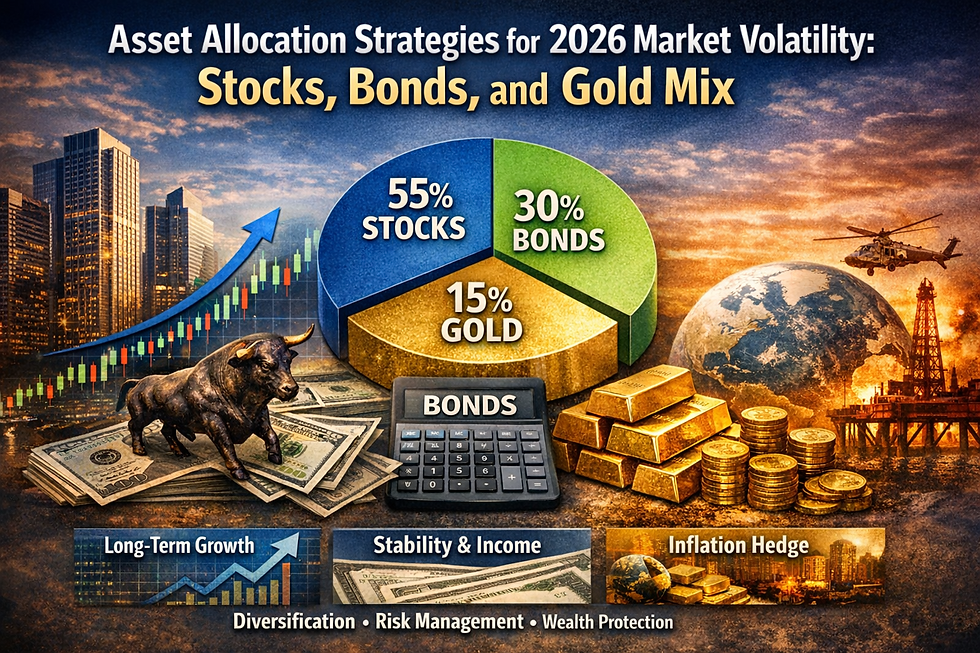
For investors seeking both growth and stability, the following balanced portfolio structure is particularly effective in volatile markets:
Asset Class | Allocation | Purpose |
Stocks | 55% | Long-term growth |
Bonds | 30% | Stability and income |
Gold | 15% | Inflation hedge and crisis protection |
This allocation offers:
High growth potential through equities
Portfolio stability through bonds
Risk protection through gold
Such diversification significantly reduces the impact of sudden market shocks.
Dynamic Rebalancing: The Key to Maintaining Portfolio Efficiency
Even the best asset allocation strategy requires periodic rebalancing to maintain optimal risk exposure.
Over time, asset prices fluctuate and shift portfolio weightings. Without adjustments, investors may unintentionally take on excessive risk.
Recommended Rebalancing Frequency
Quarterly review of portfolio performance
Annual rebalancing of asset allocation
Immediate adjustments during major market shifts
Rebalancing ensures the portfolio consistently aligns with the investor’s risk tolerance and financial goals.
Risk Management Techniques for 2026 Investors
Effective asset allocation is strengthened by disciplined risk management.
Diversification Across Instruments
Within each asset class, investors should diversify across multiple instruments, such as:
Stocks across industries
Bonds with varying maturities
Multiple gold investment vehicles
Maintaining Liquidity
Keeping 5%–10% in liquid assets allows investors to capitalise on market opportunities during corrections.
Avoiding Overconcentration
Overexposure to any single sector or asset class increases vulnerability to market shocks.
Balanced diversification ensures smoother long-term portfolio performance.
Long-Term Wealth Creation Through Strategic Allocation
Successful investing is rarely about predicting short-term market movements. Instead, it relies on disciplined asset allocation and long-term consistency.
Investors who maintain diversified portfolios across stocks, bonds, and gold are better equipped to handle market turbulence while steadily growing their wealth.
The 2026 financial landscape will reward those who adopt strategic, balanced, and adaptive investment approaches. By allocating assets intelligently and rebalancing regularly, investors can protect their capital while benefiting from emerging opportunities across global markets.
A diversified portfolio remains the most reliable strategy for building sustainable financial growth in volatile times.


Comments