


Oct 71 min read
Oct 71 min read
Oct 71 min read
Oct 71 min read
Oct 71 min read
Jun 83 min read
USE THIS SPACE TO PROMOTE YOUR BUSINESS
Understanding personal loan interest rates by credit score is essential when we aim to secure affordable credit and optimise long-term financial outcomes. Lenders price risk with precision, and credit score tiers directly influence the annual percentage rate (APR), approval probability, loan limits, and repayment flexibility. This guide delivers a complete breakdown of how rates are determined, what borrowers can expect across score ranges, and how we can strategically position ourselves for the lowest possible rates.
Lenders evaluate risk using statistically validated credit models. A higher credit score signals lower default probability, which translates into lower interest rates and better loan terms. Conversely, lower scores trigger higher APRs, stricter conditions, and sometimes reduced loan amounts.
Personal loan pricing typically factors in:
Credit score range
Credit history length
Payment history
Credit utilization ratio
Debt-to-income (DTI) ratio
Recent credit inquiries
Employment stability
Among these, credit score remains the primary pricing variable.
Below is a realistic breakdown of average APR ranges based on credit score tiers in 2026:
Credit Score Range | Rating Category | Typical APR Range |
800 – 850 | Exceptional | 5.99% – 8.49% |
740 – 799 | Very Good | 7.49% – 11.99% |
670 – 739 | Good | 10.49% – 17.99% |
580 – 669 | Fair | 18.00% – 26.99% |
300 – 579 | Poor | 27.00% – 36.00%+ |
The difference between a 620 score and a 760 score can result in thousands saved over the life of the loan.
Let us consider a ₹500,000 equivalent loan (or $10,000 in USD markets) over 3 years:
At 7% APR → Total interest ≈ significantly lower
At 25% APR, interest cost can nearly triple
Even a 3–5% APR difference materially alters the repayment burden.
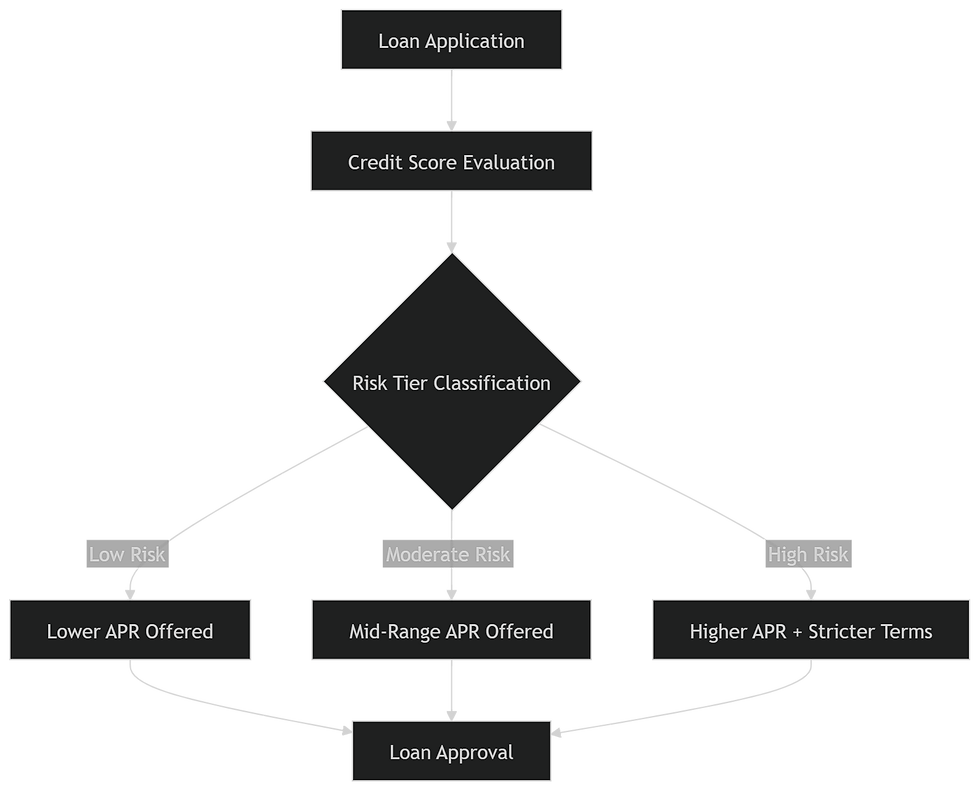
Lenders use predictive risk models that estimate default likelihood. The pricing logic follows a structured framework:
flowchart TD
    A[Loan Application] --> B[Credit Score Evaluation]
    B --> C{Risk Tier Classification}
    C -->|Low Risk| D[Lower APR Offered]
    C -->|Moderate Risk| E[Mid-Range APR Offered]
    C -->|High Risk| F[Higher APR + Stricter Terms]
    D --> G[Loan Approval]
    E --> G
    F --> G
The system ensures rate differentiation aligned with borrower risk category.
Borrowers with excellent credit benefit from:
Lowest APR bands
Higher loan limits
Flexible repayment tenures
Minimal origination fees
Fast approvals
At this level, lenders compete aggressively, often offering promotional or relationship-based rate discounts.
We observe that this segment receives strong but not prime-tier rates. Approval likelihood remains high; however:
APR spreads widen
Loan terms may vary
Fee structures become more prominent
Improving a score from 690 to 720 can meaningfully reduce APR offers.
Borrowers in this range face:
Double-digit APRs
Higher origination charges
Lower maximum loan caps
Potential co-signer requirements
Strategic pre-application credit improvement often yields better pricing leverage.
Here, personal loans become expensive due to elevated default risk. APRs may approach regulatory caps. Alternative structures such as secured loans or co-signed loans often provide better cost efficiency.
Most personal loans offer fixed interest rates, meaning:
Predictable EMI payments
Stable amortization schedule
No exposure to benchmark rate fluctuations
Variable-rate loans may begin lower but can increase depending on market benchmarks.
Even with a strong credit score, a high DTI can increase rates. Lenders typically prefer:
DTI below 36% (ideal)
DTI under 43% (maximum tolerance for many lenders)
Lower DTI improves negotiating power.
APR incorporates:
Base interest rate
Origination fee
Processing fee
Risk premium
Administrative charges
True cost comparison requires evaluating APR rather than nominal interest rate alone.
Lower revolving balances immediately boost scoring models.
Consistent on-time payments significantly increase rate eligibility.
Excessive credit applications suppress score thresholds.
Documented stable employment strengthens the underwriting profile.
A strong co-applicant can substantially reduce APR offers.
Pre-qualification uses soft enquiries and does not affect credit score. Hard applications can temporarily reduce scores by 5–10 points.
Strategic pre-qualification across lenders allows rate comparison without score damage.
Loan Type | Collateral Required | Average APR |
Unsecured | No | Higher |
Secured | Yes | Lower |
Secured loans typically offer lower interest rates due to reduced lender risk exposure.
Longer tenure:
Lower monthly payment
Higher total interest cost
Shorter tenure:
Higher EMI
Lower cumulative interest
Balancing cash flow and total cost is critical.
Applying with unstable income
Ignoring credit report errors
Accepting first offer without comparison
Carrying high revolving balances
Choosing excessive tenure
Precision in preparation improves pricing outcomes.
Action Taken | Estimated Score Impact | Timeline |
Paying down balances | Moderate to High | 30–60 days |
Disputing errors | Variable | 30–90 days |
Removing late payments | High | 3–6 months |
Building payment history | Gradual | 6–12 months |
Even 60 days of preparation can shift rate categories.
Optimal timing includes:
After recent score increase
After major debt reduction
During stable employment phase
When market benchmark rates decline
Strategic timing enhances approval and pricing leverage.
Personal loan interest rates by credit score reflect measurable borrower risk and pricing algorithms. The difference between tiers is substantial and financially decisive. By optimising credit profile, managing debt ratios, and strategically comparing offers, we position ourselves in the lowest risk category—unlocking competitive APRs, stronger approval odds, and meaningful long-term savings.
Careful preparation transforms borrowing from a costly obligation into a structured financial tool aligned with strategic wealth management objectives.


Comments